
Every operations manager running propane trucks has heard the pitch for electric. The question they ask back is a fair one. Will it hold up on a 20-hour day?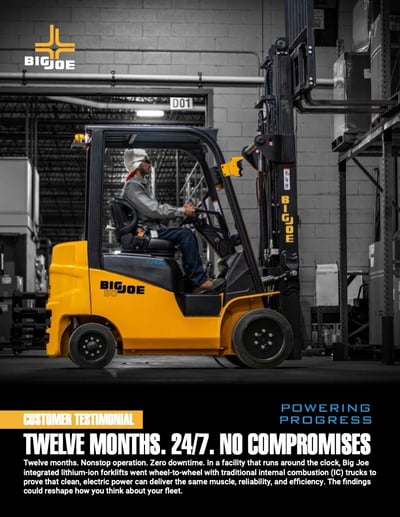
A high-output injection molding plant in Texas decided to find out. In early 2025, the facility put Big Joe integrated lithium-ion counterbalance forklifts to work in its 24/7 operation with one goal. Prove the trucks could replace its older LPG units without changing how the plant runs.
Twelve months later, the data is in. Zero downtime, all year. Here's what one of those trucks did.
The operation
Injection molding doesn't stop for shift change. Trucks at this plant run more than 20 hours on peak days, with short windows to charge. Management also wanted predictable energy costs and lower emissions without giving up uptime.
Each truck was spec'd with a 36.8 kWh integrated lithium-ion battery and charged on a 12 kW external charger. Big Joe Pulse telematics, standard on every Big Joe Class 1 truck, recorded every hour.
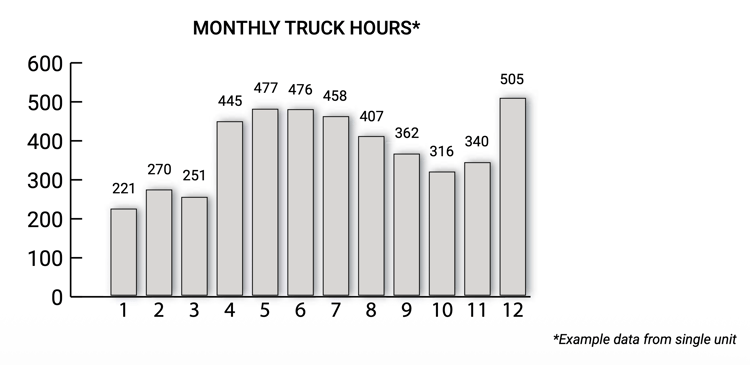
4,528 hours in one year
- 4,528 operating hours in 12 months
- In use 342 days of the year, including a run of 192 straight days with use every day
- An average of 13.2 hours a day, with 37 days at 20 hours or more
- 505 hours in the final month, or 16.2 hours a day
Those are typical numbers for an LPG truck in a high-hour application. This truck hit them on electricity.
How it kept up: charging on the clock
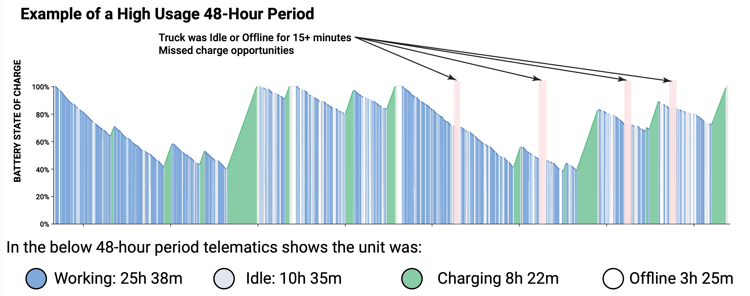
Integrated lithium-ion doesn't need long charge cycles or battery swaps. Operators can plug in whenever the truck is parked. On this plant's 12 kW charger, a 15-minute opportunity charge added about 8% state of charge. In month 12, the busiest month of the year, the operation was never once slowed down by a low battery. The truck finished the year with zero downtime.
Pulse also showed where there was room to do better. In one high-use 48-hour stretch, the truck logged:
- 25 hours 38 minutes working
- 10 hours 35 minutes idle
- 8 hours 22 minutes charging
- 3 hours 25 minutes offline
Pulse flagged every idle or offline period of 15 minutes or more as a missed chance to charge. That kind of detail helps a manager tighten charging habits, plan shifts and protect battery life, all from data the truck is already collecting.
Regenerative braking added free run time
Every time an operator slows down, regenerative motor braking sends energy back into the battery. Over the year, it recovered 602 kWh. In the last three months of the study, regen powered an average of one hour of work a day, and up to 1.75 hours a day. Overall, it extended run time by 6.1%.
The cost comparison
Pulse split the truck's 4,528 hours into 2,661 working hours and 1,867 idle hours. That split matters. An electric truck sitting key-on uses almost no energy. A propane truck sitting idle keeps burning fuel.
|
Big Joe integrated lithium-ion |
Comparable LPG truck (est.) |
|
|---|---|---|
|
Energy used |
9,192 kWh |
2,048 gal. LPG |
|
Energy cost |
$0.09/kWh |
$3.00/gal. |
|
Cost while working |
$927 |
$4,761 |
|
Cost while idle |
$0 |
$1,382 |
|
Total for the year |
$927 |
$6,143 |
LPG figures are based on publicly available or manufacturer-stated energy consumption data for comparable LPG forklift models.
What that means for one truck:
- More than $5,200 in fuel savings in one year
- About 20 cents per operating hour to run
- $1,300 in idle costs eliminated, money an LPG truck would have burned just sitting still
- No propane deliveries, no tank changes and energy costs that don't swing with fuel prices
No exhaust on the floor
Integrated lithium-ion trucks produce no exhaust inside the building. The only emissions come from the grid while charging.
Using EPA averages for the Texas grid, the electric truck accounted for about 7,060 lb. of CO2e over the year. A comparable LPG truck would have produced about 25,950 lb. That's 18,890 lb. less per truck, the equivalent of taking 1.75 passenger cars off the road.
What it means for your fleet
The plant set out to answer one question. Can integrated lithium-ion replace LPG in a high-hour operation without hurting the work? After 4,528 hours and zero downtime, the answer was yes.
If your facility runs LPG trucks on long shifts, start with your own numbers. Your Big Joe dealer can look at your hours, shift patterns and charging windows with you and help size the right truck. Big Joe Pulse then gives you the same visibility this plant had from day one.
Explore Big Joe Class 1 forklifts | Run your numbers with the ROI calculator
Ready to see it in your operation? Contact your local Big Joe dealer to schedule a demo.
TAGS: